Had you asked me this question a few months back, my answer would have been different from what I'm going to tell you now. Earlier, I'd have said something like,
- Captrice has a smart metronome that tracks and remembers your progress
- The collected metronome data can be visualized, helping with gamification and motivation to practice consistently
- You can create your own exercises and organize them into collections. Having an always available list of exercises prevents decision fatigue when one sits down to practice
This was pretty much my pitch to users, guitar teachers and any one who was curious. While all of these points are still 100% true, they don't do a good job of explaining the underlying reason why the app works. Me, the developer of the app, saying that "it works for me, so it will work for you too" is not a very convincing selling point either.
Neuroscience behind learning music
Lately I've been reading books and research papers on the topic of learning and practicing music. It has led me to realize that the reason why Captrice works is not arbitrary but has strong neuroscientific backing. There's enough literature on this topic if you want to go down the rabbit hole, but the one book that was my gateway into this fascinating subject is Anyone can play music by Josh Turknett, a neurologist and a banjo player.
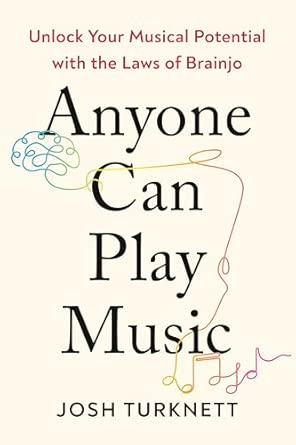
A core takeaway from the book, and a common theme that you will find in other papers too, is that learning and practicing music that we find challenging brings about structural and functional changes in our brain. When we practice with the aim of mastering a difficult thing, our brain gets the signal that a neural network needs to be created for that activity to be performed effortlessly. Through regular, consistent repetition, the signal gets reinforced. This is the reason why you won't be able to really learn a challenging piece by playing it just once. The experience is often like, "I kept practicing and failing for a few days and then it suddenly clicked" or "it felt like a new skill was suddenly unlocked".
Once the neural network is formed, the activity becomes as good as automatic. i.e. driven by the subconscious more than the conscious mind. You may find it relatable if you've learned how to drive a car — a novice on their first day behind the wheel is ultra focused on the mechanics of driving itself, while also having to keep their eyes on the road and surroundings. But after a few months, the same person can easily drive in busy traffic while simultaneously listening to the radio. Turknett puts it rather nicely — "moving from conscious incompetence to subconscious competence".
Interestingly, our brain only remembers the things that we do with focus and attention. Everything else deserves to be forgotten by design. Deliberate practice signals to the brain that the activity is important and worth creating a neural network for. But how can an app help with this? Turns out that the features that are built into Captrice facilitate highly focused deliberate practice. You have to think of Captrice as a set of practice tools. Unlike several other apps that package and sell courses, Captrice focuses on enabling and assisting musicians with the activity of practicing — the essential work one has to put in, in order to actually get better.
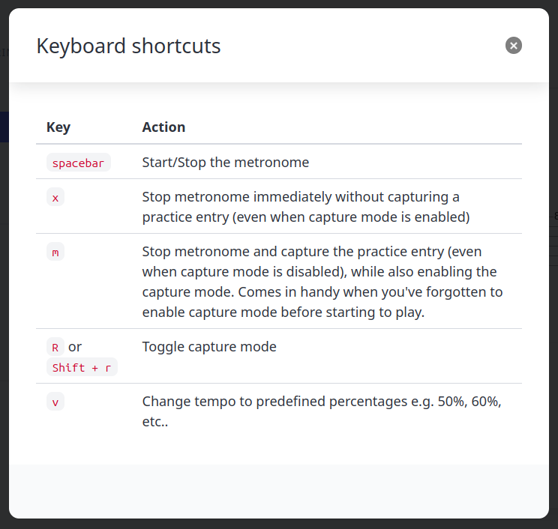
Let's take the example of speed building — the most common use case of metronome-based repetitive practice. An underrated feature of Captrice in my opinion is that the metronome can be operated using keyboard shortcuts while holding the instrument. Just press the space bar to stop and start the metronome. The app takes care of increasing the tempo in fixed intervals. You don't need to grapple with the mouse pointer, text boxes, sliders, knobs and other types of skeuomorphic user interface in between repetitions. As you push through gradually incrementing speeds, you can stay focused on listening to the clicks and ensuring that the right notes are landing on the right clicks. "Start at a slow tempo, then gradually increase it" is a common advice you must have heard, but what they don't tell you is that you need to really listen to the clicks while playing with the metronome. Otherwise, simply increasing the tempo in any number of steps is not going to help that much. The keyboard shortcuts remove UI-driven interruptions and lets you focus on what matters.
As you push yourself towards the "target" or "performance" speed, there will be a point when it will start getting increasingly difficult to focus on the clicks. That's your cue that you've reached a break point or the "edge" speed. To be able to play faster, you need to overcome this edge and keep pushing it slowly, steadily and honestly until you can play comfortably at that speed.
Behind the scenes, Captrice captures data i.e. the tempo, number of bars and the time duration you played for at that tempo. During practice, none of it matters. But after the session, you can look back at it and draw useful insights. The data will clearly reflect the edge tempo for each session. It will also tell whether you were able to push the edge further as compared to the previous session. The Journal feature can be used to jot down the things you noticed or observed about your playing or anything that's worth remembering for future sessions.
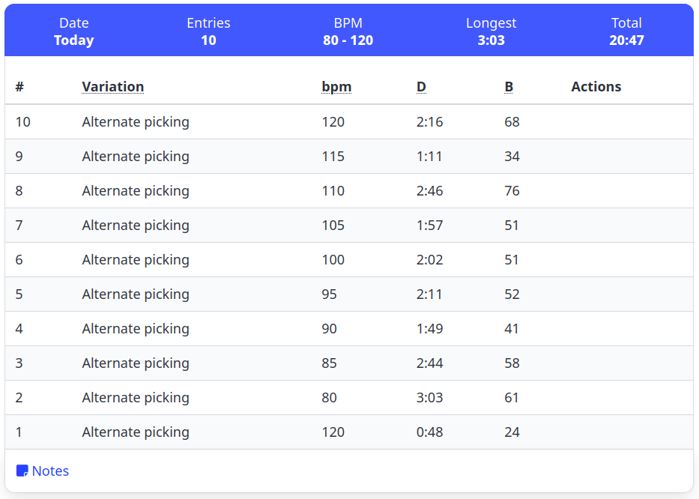
The captured data also helps track progress, both at a macro and micro level. My personal use case is to track the edge tempo across practice sessions by comparing the speed vs the duration I could play for at that speed. If I am able to play faster for longer duration without losing accuracy due to fatigue, it indicates progress.
Another common workflow is to begin a new session where you left off last time. Suppose you want to master a fast solo or a lick. With that goal in mind you sit down to practice and end up spending 2 hours at a stretch. You'd certainly feel satisfied about a long practice session that day, but how much progress do you think you were able to make towards the goal? To put it differently, if you are asked to play the same lick a week later, do you think you'll be able to play it as fluently as you could play during the last practice session? It's unlikely, because to master a difficult thing, your brain needs to get the "this-is-important" signal over and over again. Moreover, the brain will take its own time to create the neural network (most of which will, quite interestingly, happen during sleep). A common misconception is that you need to put in long hours to be able to play an instrument. But actually, it's better for deliberate practice to be short and highly focused. After about 20-25 mins, there are diminishing returns and you start naturally losing focus as well. It'd be much more effective to come back to the exercise after a break, perhaps in a few hours or a day later. And at that time, if you get to see your recent edge speed, you can start from that point. This way you are focused towards the goal without wasting any time.
Shorter practice sessions have second order effects too. When you know that only about 20 mins are sufficient for a productive practice session, it feels much more doable than trying to carve out a 2-4 hour block in your daily routine. This indirectly helps with consistency.
Understanding what you're doing
Practicing music is more than building neural networks for motor skills. Those govern the mechanics of the instrument, which is nothing but a device that produces sound. The musical ideas originate in the brain and then get expressed through the hands of the player. When you look at it this way, it also matters whether or not you understand what you are doing. Without understanding, any amount of practicing and hard work will get you only so far. I am saying this from personal experience.
As the developer of the app, one guiding principle I've followed since the beginning, is to avoid spoon-feeding the user. I believe that "dumbing it down" for beginners doesn't actually help them. The only thing it might help with is quick adoption of my app in the short term. In Captrice you won't see instructions like "place your second finger on third fret of the fourth string" which I believe is a ridiculous way to teach and learn, especially when both parties are capable of understanding and communicating concepts. Similarly, the app doesn't try to listen and evaluate whether you played the right note at the right instant through software. For that we have the most sophisticated device available — our ears!
Captrice's goal is to help self-motivated guitar players at any level to incrementally and sustainably build the necessary skills to level up. Any learning material you have access to, whether it's a lesson given by your teacher, a course you purchased online or an exercise you came up with yourself, can be added to it and practiced with the tools it provides.
The new roadmap
So far, a big part of my drive to build Captrice has been personal experience and anecdata. But it turns out that my experience has solid backing from the field of neuroscience, especially the topic of neuroplasticity of the brain. Secondly, I've realized the importance of designing and presenting the tools in a way that helps beginners understand the various concepts in music. This newfound clarity has led me to re-evaluate the roadmap. I am extremely excited about building features that prove to be truly useful and efficient practice tools for guitarists at all levels.
Metronome-based practice to improve technique, timing and speed is just one aspect of practicing guitar. In the coming weeks and months, I plan to ship tools for other types of practice. A lot of work is already underway. I don't want to reveal much in this post, but if you are a self-motivated student of guitar/music you definitely want to subscribe to the newsletter and stay updated!
In the meanwhile, a premium version with remote backups is in the works too. This will also unlock cross device sync capability to an extent. I think it'll be a good stopgap until a proper (and much more complex) cloud sync functionality is implemented. Being able to switch between desktop and phone is something I've been wanting myself for a long time.
Again, if you find all this interesting, I'd encourage you to subscribe to the newsletter and get the updates in your inbox. Thank you for stopping by and reading this far. This is the very first Captrice blog post and there are many more to come.