Tablature is a crutch. There I said it! It probably sounds strange coming from me considering that Captrice itself has a tablature editor built into it. To be clear, I'm not against tablature and I genuinely believe it has a place in a guitar player's toolkit. The problem is that it commonly gets used for the wrong things, which ends up hurting one's progress as a musician. So if you'll excuse the slightly clickbait title and are open to a nuanced take on guitar tablature, read on.
My own experience with tablature
When I started learning guitar in 2001, tablature was already an established notation system, and I could find tabs on the internet for any song I wanted to learn. In those days tabs were more freely available (these days they are mostly behind a monthly subscription or a Patreon membership). Most teachers I knew insisted on learning by ear but we students felt it was a conservative opinion. Then came Guitar Pro, and it was impossible to ignore it — interactive tablature with sound, plus the ability to mute/solo individual tracks so you could use it as a backing track too.
So back then, I'd mostly learn from tabs and Guitar Pro files. In retrospect, I had no clue what I was doing. It was like rote learning. If I fumbled mid-way through a solo, which would happen often when playing in front of an audience or camera, I couldn't recover. While I relied on tabs too much, I also half-assed my way through learning from them. When I encountered a passage or riff that was way above my competence, just for that bit, I'd ignore the tabs and go with whatever felt comfortable. In short, I didn't push myself to nail the difficult parts.
Over time I realized that I wasn't so bad at figuring out a tune by ear so I became more open to the idea of learning by ear. Not like I completely stopped using tabs, but I'd at least attempt the easier parts on my own first. This approach served me well for many years, but lately I've been pushing myself to strictly learn everything by ear. It takes longer but as a hobbyist, I don't have a deadline to meet. And more importantly it's far more rewarding.
Problems with tablature
I am a bit skeptical of those who are strictly against tablature. In general, I'm wary of absolute positions on anything that has clear trade-offs, and tablature is one such thing. The benefits are obvious, but so are the problems. Acknowledging and understanding the problems is the first step towards being able to use it wisely.
An obvious problem with tablature is that it can be wrong. Even if it's readily available to you, someone must have transcribed it. And if they made any mistakes, you'd inherit them too.
Secondly, it's essentially a lossy medium i.e. it can't exactly represent how a musical piece sounds. It can tell you that you need to play a particular note with a vibrato but a vibrato can be played in a hundred different ways. So if your goal is to play a David Gilmour solo note for note, you need to carefully listen to it anyway, to be able to incorporate all the subtleties that make it sound the way it does. Once you develop the knack for figuring out notes, you'll realize that the notes are actually the easy part and the difficult part is to replicate the feel. For that you need to listen to every little detail. So you might as well skip the tablature and develop the skill to listen.
Third, by using tablature you're missing out on exercising two important muscles that will make you a fluent musician in the long term - (1) active listening (2) mapping a sound in your head to the fretboard.
Have you ever witnessed a jam session between expert musicians where they are improvising together? Throughout their performance, you'll see that they are listening to each other and the music they create is merely a response to it. In contrast, a clear sign of an amateur is that they tend to play from memory. Forget improvisation, their mind is busy with the task of remembering and there's no bandwidth to pay attention to the accompanying music.
Being able to map a sound in one's head to the instrument is how music gets created. Music originates in our brain and the instrument is merely a device we operate. A skilled musician who has put in the work focusing on the right skills will be able to fluently articulate their musical thoughts through it. Trying to learn a song by ear helps build both these skills. It's a slow process so don't expect immediate results.
There's another problem with tablature that's rather interesting. I got it from the book Anyone can play music by Josh Turknett and it was quite an eye-opener for me. If your idea of deliberate practice is to fire up tablature, you will get better at reading tablature and visually memorizing numbers. It goes the same way for game-based learning apps — you get better at playing the game. These skills are practically of no use when it comes to improvisation or composing music, an essential requirement for calling yourself a musician. Because tablature helps you move forward with whatever you wish to play, it gives the perception of progress. Sure, you'll see some improvement as a side effect of learning something new but it's not deliberate and you're not necessarily growing musically.
Finally, I've observed that my mind stops working the moment I learn from a ready-made answer. When I use tabs, I tend to ignore the notes and intervals, something I'm forced to think about when learning by ear. By not working it out myself, I am skipping the process that helps me understand concepts and make new connections with my existing knowledge.
Advantages of learning songs by ear
We already covered a few of these in the previous section. But an important one worth stating explicitly is that it forces you to pay attention to things that you tend to otherwise overlook — the key of the song, the time signature, intervals between notes, octaves, chord progressions and voicings, etc.
Beyond that, there's a more fundamental advantage — learning by ear is itself a skill, and like most skills, it gets better with practice. The first few times you try to figure out a melody or work out a chord change, it can feel painfully slow and frustrating. But if you keep at it, your ears will start identifying the notes and intervals faster and you may even start recognizing patterns.
But does any of this really matter if you're "just" a hobbyist? That's a common pushback I get on this topic. I think it does. At the minimum, a hobby should be fun, but it should also amount to something, without which you'd not be motivated to pursue it as a hobby. For instance, when presented with an opportunity to perform, if you're not able to confidently play the same stuff you play in your bedroom, it'd be rather discouraging. A mindset shift is required in how to qualify and quantify learning and progress when it comes to pursuing guitar as a hobby. I'd say that if you can only practice for 30 minutes a day, spending that time figuring out four notes by ear will serve you better than learning an entire solo through tablature (only having to use tabs again next time).
What does tablature help with then?
I started this post by saying that tablature has a place in a guitar player's toolkit. Despite the problems mentioned above, it's an easier notation format. Newcomers find it much more accessible than standard notation, especially if they haven't been introduced to music theory yet.
That makes it a great tool to communicate musical ideas with players at all levels. It's a completely text-based format and as such you don't need any software to write it, which makes it a great medium to store and preserve music, both physically on paper as well as digitally on a computer. Guitar teachers often share lessons in the form of tablature at the end of a session for the students to refer to when practicing at home. The same logic applies if you're a self-learner like me who often comes up with your own exercises — you can write it down as tablature for your future self.
Guitar exercises are mostly meant for warm up, finger independence, developing technique, building speed etc., and most of them don't really sound musical. So there's not much value in learning them by ear. By all means use tabs in those cases so that you can quickly get to practicing and working on the skills that they are meant for.
When it comes to learning songs, it's best to avoid tabs. But once you learn a song by ear, you can take it to the next level by trying to transcribe it yourself. You may not share it with anybody but the process will force you to notice things that you usually don't pay attention to, mainly the duration of notes and how they fit into the time signature.
Captrice is not tablature software
Many people incorrectly assume that Captrice is tablature software. I think there are two reasons for this:
-
When a new user imports a library collection, the first thing they see on the practice page is the tablature. I transcribe these exercises myself, and my intention behind it is to communicate how to play the exercise. I think expecting a new user to learn from the accompanying video would be asking too much of them.
-
Whenever someone watches a demo video showcasing Captrice, the first thing their eyes latch on to is the tablature. It's the most visual element on the screen. So they assume that's the whole point of the app.
Some users have also asked me if Captrice supports Guitar Pro files. AlphaTab, the open source project that powers the tablature editor and the MIDI player in Captrice, does support Guitar Pro as an input format. So adding support for it should be straightforward. But I've been reluctant about it (more like resisted the temptation to add it) because I believe it'd send the wrong signal.
Some uses for the tablature editor
The tablature editor in Captrice still has its value. As mentioned before, tablature is an accessible, low-barrier medium to share exercises or musical ideas. So if you're a teacher, you may use Captrice to transcribe and share exercises with your students. If you're someone who comes up with their own exercises, then you may transcribe them for your future self.
Once you learn a song or a tune by ear, you may transcribe it simply to build those skills. In my experience, when you learn music by ear, you don't feel the need for tablature because, (1) learning by ear helps with better memorization and (2) as you get better at it, you can easily learn it again in case you forget. But here the outcome i.e. the resulting tablature, is not as important as the process. Being able to transcribe, even if it's not the standard notation, is undoubtedly a skill worth developing.
AlphaTab comes with a native text-based input format called AlphaTex, which is what Captrice uses. It's well documented and quite easy to learn. Especially for teachers, maintaining their learning material would be much easier in text format as compared to images or pdf files.
The MIDI player in Captrice also comes in handy to verify that the tablature you wrote actually sounds like what it should. You're not transcribing into the void. Any mistakes can be caught immediately by playing it through the MIDI player.
How to learn by ear?
As this post advocates against using tablature, I think it'd be incomplete without discussing how to go about learning by ear.
Trial and error
The easiest way to get started is to listen to the song and try playing the notes on your guitar at the same time. It's essentially trial and error, so focus on one small section at a time. I recently added a section looper in Captrice for this exact use case. It lets you select and loop a specific portion of the embedded YouTube video. The looper can be controlled using keyboard shortcuts for things like rewinding or adjusting the playback speed. YouTube uses a pitch-shifting algorithm, so slowing down the track doesn't lower the pitch, which makes it a great fit for this use case. The looper is meant to be the first piece of a larger feature-set I'm working on to help users learn songs by ear. Just like the metronome, Captrice captures the time duration that you use the section looper for and treats it as practice time.
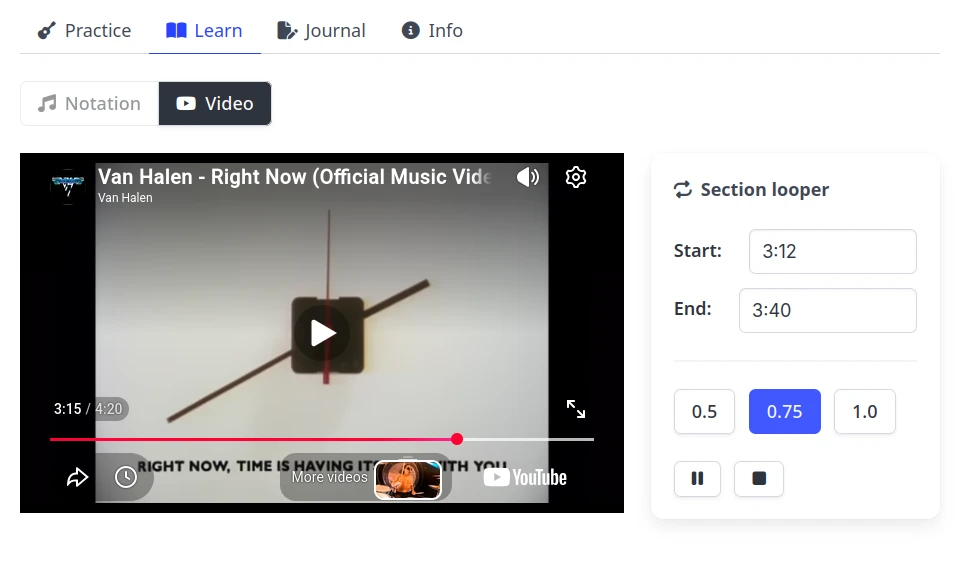
Here are some tips to use the trial-and-error approach effectively:
-
You may find it easier to work on melodies (i.e. a tune, riff or guitar solo) than harmonies (the chord progression) in the beginning.
-
It helps to figure out the root note or the key the song is in. Paying attention to the bass line often helps with that. Typically, the root note will give you the feeling of resolution or home in the song's context. Note that it may not always be the first note or the first chord, which is a common misconception (Hey Joe by Jimi Hendrix is a good example). So, focus on the chord that the progression resolves to instead.
-
If it's a long guitar solo, try breaking it down into smaller sections. Think of each section like a sentence in a paragraph, one leading into the next. In most cases, you'll find that the sections correlate with the rhythm and chord progression cycles.
-
When you come across a part that seems too difficult, perhaps because it's too fast, create an exercise out of it in Captrice and practice it with the metronome.
-
Before you try working out a song by ear, make sure that you've listened to it enough times that you can hum the tune from memory. Otherwise it'll be difficult to remember the parts you've already worked out.
Ear training
While learning by trial and error generally works, eventually you'll find it limiting. If you want to be able to learn anything by ear confidently and quickly, you can't escape ear training. Ear training is nothing but practicing how to recognize patterns such as relative intervals, types of chords etc. just by listening. Believe me, it's a game changer and I regret that I didn't take it seriously earlier. Even if you're a beginner, I suggest you start ear training immediately after learning about intervals. You can practice anywhere at any time, as the instrument is not required. Captrice doesn't have any tool for ear training and I haven't yet decided if I'll ever build one in future. There are already so many apps on the internet. After trying out a few, I've settled on Chordistry and have been using it for a while now. Like Captrice, it's a login-free web-based app that you can access in any browser of your choice on PC or mobile. It comes with many useful tools.
Recently I came across an innovative ear training app, Resolve, which calls itself reactive ear training app. The brilliant guitarist Tom Quayle is behind it. Check out the demo by Tom himself. It's a paid app and I'm holding off buying it because right now I am not really working on my improvisation skills, which is what I feel the app would help with the most. But it looks really promising and I definitely plan to explore it soon.
A quick peek at tablature or a video
Having said all that, at times it's ok to use an external reference, including tablature! An important part of leveling up as a musician is to push yourself out of your comfort zone. In doing so, you may come across a lick that you find impossible to figure out by trial and error. In such cases, you can take a quick peek at the tabs (and immediately keep them away) instead of being blocked indefinitely. The Anyone can play music book also talks about this.
You may also watch a video of someone playing it where you can see the notes they're playing. This comes close to a teacher or a friend showing you how to play something.
The important thing is, make sure you use an external reference only for the difficult bits and once you learn them, try to understand what you were missing. That way, not being able to learn it yourself wouldn't feel like failure and in fact, it'll contribute back into the learning process.
In summary
-
Captrice is not tablature software. That's not the primary goal of the app.
-
Tablature is indeed a crutch. It gives the perception of learning songs fast but actually slows down your progress as a musician in the long term. This applies to hobbyists too, because without real progress, they will get demotivated and stop pursuing guitar as a hobby.
-
Learning songs by ear is an important skill and once you get started, you'll quickly realize that it's not that difficult.
-
When you want to learn a song, don't reach for the tabs immediately. Spend some time figuring it out yourself. Eventually it's ok to use tabs for the impossible bits.
-
Instead of relying on tablature software, explore and experiment with tools that help you learn by ear, such as YouTube's playback speed adjustment option, the section looper in Captrice and the various ear training apps available on the internet.
-
Learning to transcribe music is a worthwhile skill to develop and you can leverage the AlphaTab editor and the MIDI player in Captrice for it.
Thanks for reading thus far. Whether you're a beginner, an intermediate player or even a teacher, I'd love to know your thoughts. Feel free to email me at vineet@captrice.io.